
Pug facts for kids

A fawn-colored Pug, the most common coloring.
|
|||||||||||||||||
| Origin | China | ||||||||||||||||
|---|---|---|---|---|---|---|---|---|---|---|---|---|---|---|---|---|---|
|
|||||||||||||||||
|
|||||||||||||||||
| Domestic dog (Canis lupus familiaris) | |||||||||||||||||
The Pug is an ancient and popular breed of dog known around the world. These dogs have wrinkles on their faces, very short snouts, and curly tails. Their fur is short, very soft, and shiny. Pugs usually have fur that is fawn, which is a light tan, or shiny black. They have square, sturdy bodies with strong little muscles. Pugs are famous for being loving pets who love staying near people.
Centuries ago, travelers brought these friendly dogs from China across the oceans to Europe. Important royal families in the Netherlands and Britain welcomed them into grand palaces. Famous rulers like Queen Victoria loved keeping them as faithful friends. Today, pugs are recognized as affectionate companion pets. They are wonderful indoor pets, though their unique flat faces mean they need extra care to stay healthy.
Contents
What Is a Pug Dog?
The pug is a small toy breed that has brought happiness to human homes for thousands of years. Many animal experts classify the pug as a true companion dog. That means breeders created them specifically to provide affection and companionship rather than to work on farms. They belong to the broader biological canine group known as Canis. Throughout history, people have loved them because they are cheerful, gentle, and quiet housemates.
The American Kennel Club describes the breed as charming and well-behaved. They have an easygoing nature and love playing with children and adults. Because they do not need massive amounts of exercise, they make wonderful pets for small apartments. They love curling up on sofas next to their favorite human friends.
Where Did the Word Pug Come From?
People have wondered about the word "pug" for centuries, and several fun explanations exist. One idea links the name to a small pet monkey called the marmoset monkey. During the 1700s, people called this tiny monkey a "pug-monkey" because of its sweet, flat face. Because the dog shared similar facial expressions, people may have given it the same name.
Another idea suggests that the word came from the Latin word "pugnus," which means a clenched fist. When viewed from the side, a pug's round head and wrinkles look like a closed fist. The famous Oxford English Dictionary records that the word once described playful little creatures or friendly imps. Long ago, people used the term as an affectionate pet name for cute animals like foxes, rabbits, and sheep. By 1749, writers began using the complete term "pug-dog" in English books.
What Do Pugs Look Like?

A modern pug has a very sturdy, compact shape that experts often describe as a cobby body. This means they are thick-set, low to the ground, and built like little squares. They have wide, deep chests and strong legs. Pugs are famous for their tails, which curl up tightly over their hips. Some dogs even have a double curl, which dog judges admire.
Their coats are short, smooth, and soft, requiring regular brushing to remove loose hair. Coat colors include silver fawn, apricot fawn, warm fawn, and solid black. Pugs often have distinct black masks over their snouts and dark ears. Many also show a delicate dark line along the spine from the neck to the tail.
A pug has a broad head with deep facial wrinkles. Their ears are soft like black velvet and fold over smoothly. Dog breeders recognize two main ear types: "button" ears and "rose" ears. A button ear folds forward neatly against the cheek, while a rose ear folds backward slightly. Most show judges prefer the tidy button shape. Their lower jaw usually sits slightly forward, giving them a cute little underbite.
Personality and Daily Behavior
The official Latin motto of the pug breed is multum in parvo, which means "a lot in a little." This phrase shows that a tiny pug holds a huge amount of personality inside its small body. Pugs understand how people feel and change their energy to match their family. When you want to run around outside, they play happily. When you want to sit quietly and read, they snuggle beside you.
These affectionate little dogs love following their owners from room to room. Because of this devoted habit, owners often call them friendly little "shadows." Unlike hounds bred for hunting or collies bred for herding, pugs were bred purely for companionship. They do not enjoy being left alone outside for long periods because they thrive on human love. They are rarely aggressive and enjoy meeting guests, neighbors, and other household pets.
Ancient History of the Breed

Ancient Chinese Origins
The fascinating story of the pug begins in ancient China thousands of years ago. Historians believe the ancestor of the pug was a beloved dog named the Lo-sze. This ancient dog had short legs, a compact body, and very short fur. It lived alongside another famous Chinese breed, the fluffy Pekingese. Both types of dogs enjoyed royal treatment in imperial palaces.
During the grand Song dynasty, emperors loved these little dogs dearly. Chinese royalty gave them private rooms, luxurious silk pillows, and personal attendants. Imperial guards watched over them day and night so that nobody could steal them. The Chinese valued the wrinkles on a pug's forehead because the folds formed patterns. They especially loved wrinkles resembling the Chinese symbol for prince (王), seeing it as a sign of royalty.
Monks in Tibet also welcomed these gentle dogs into their peaceful mountain homes. In Buddhist monasteries, the dogs served as faithful companions to holy teachers. Pugs learned to live calmly alongside humans, creating the sweet and peaceful temperament they carry today. Later, European traders sailed across the oceans to trade goods with Asia. Ships belonging to the famous Dutch East India Company bought these royal dogs and carried them home to Europe.
Royal Dogs in Europe
Pugs quickly became favorites among European royalty during the 1500s and 1600s. In the Netherlands, the pug became the official mascot of the noble House of Orange. According to a famous historical legend, a loyal pug named Pompey saved his royal owner's life in 1572. The clever dog heard enemies creeping toward the prince's tent at night and barked loudly, waking the prince just in time.
When William III and his wife Mary II moved from Holland to rule Great Britain in 1688, they brought their favorite pugs. Noble families in London saw the funny little dogs and wanted their own. Some historians believe that British breeders crossed these dogs with the King Charles Spaniel to give that breed a sweeter, flatter nose.
Across Europe, pugs were symbols of high fashion and nobility. In Spain, the great artist Goya painted lovely portraits of wealthy ladies posing with their pugs. In Italy, wealthy travelers took pugs everywhere in horse-drawn carriages. Some pampered Italian dogs wore tiny jackets and matching hats. While most served as lap companions, some owners even trained them as watchful guard alerts because of their sharp hearing.
The 1700s and 1800s
.jpg)
During the eighteenth century, famous artists celebrated pugs in fine art. The British painter William Hogarth loved pugs and owned several during his lifetime. In 1745, he painted a famous self-portrait featuring his loyal pet pug named Trump. Today, art fans visit that masterpiece inside London's famous Tate Gallery.
In Italy, English writer Hester Piozzi noticed that wealthy travelers filled the city of Padua with pugs. French royalty also fell in love with them. Before Napoleon Bonaparte married Empress Joséphine, she owned a smart pug named Fortune. When guards held Joséphine inside a palace during dangerous times, Fortune carried secret letters to her family under his collar.
.jpg)
In nineteenth-century England, Queen Victoria became the breed's greatest champion. The Queen loved animals and helped start The Kennel Club in 1873 to care for pedigree dogs. She owned many pugs, including favorites named Olga, Pedro, Minka, and Venus. Her love for the breed inspired her grandson King George V and great-grandson King Edward VIII to keep them too.
During that time, British dog lovers established two distinct family lines of pugs: the Willoughby line and the Morrison line. Willoughby pugs were darker with long noses, while Morrison pugs had rich golden coats, black masks, and rounder heads. British soldiers later brought more flat-faced dogs from Beijing following conflicts at the Old Summer Palace. Breeders combined these lines to produce the modern pug look. A noble traveler named Lady Brassey brought black pugs from China in 1886, making black coats hugely popular.
The Pug Across the Ocean
Pugs crossed the Atlantic Ocean to the United States during the nineteenth century. American families fell in love with their cute expressions and sweet nature. The prestigious American Kennel Club officially recognized the breed in 1885. Dedicated owners founded the Pug Dog Club of America in 1931 to protect the breed standard.
In 1981, a handsome pug named Dhandys Favorite Woodchuck won the supreme award at the Westminster Kennel Club Dog Show. This marked the first time a pug won that famous competition since it began in 1877. In 2004, another champion pug won the highest title at the global World Dog Show held in Rio de Janeiro. Pugs continue to win dog shows and appear in popular movies and television shows.
Modern Breeding and Health Care


Understanding the Flat Face
Scientists use the term brachycephaly to describe animals with shortened skulls and flat faces. Because pugs have very short muzzles, their breathing tubes are compact and crowded. This anatomy causes a medical issue called brachycephalic airway obstructive syndrome. Dogs with this condition make snorting sounds, snore loudly, and struggle to pull air into their lungs when running fast.
Because they cannot pant as efficiently as long-nosed dogs, pugs suffer easily from hyperthermia, which means dangerous overheating. Owners must keep them inside air-conditioned rooms during hot summer days. Their short noses also create breathing trouble during air travel, leading many commercial airlines to restrict carrying flat-faced dogs inside cargo holds.
Pugs also lack deep bone ridges around their eyes, meaning their round eyeballs bulge outward. This trait is known as exophthalmos. Because their eyes stick out, they easily scratch their clear cornea on plants or furniture. Scratches can turn into painful ulcers if not treated by a veterinarian. They also suffer from entropion, where eyelids roll inward and rub against the sensitive eyeball. Owners must clean facial skin folds daily to stop bacteria from causing skin fold dermatitis.
The Retro Pug Movement

Over the past century, some dog breeders selected puppies with flatter faces and shorter legs. Because this caused breathing trouble, caring dog lovers started a new project called the "retro pug" movement around 2006. These breeders work hard to return the breed to its healthier historical shape from the 1700s.
Retro pugs have longer snouts, wider nostrils, longer legs, and shallower wrinkles. By giving the dog a longer nose, retro pugs breathe easily and run without gasping for air. Their eyes sit deeper inside their skulls, protecting them from scratches. In 2023, the government of the Netherlands passed animal protection rules requiring breeders to produce healthier dogs with longer noses.
Keeping Pugs at a Healthy Weight

Pugs love eating tasty dog food and snacks, making them prone to dangerous weight gain. British veterinary studies discovered that pugs are three times more likely to become overweight than other dog breeds. In fact, veterinarians diagnose about one in five pugs with obesity each year.
Carrying extra body fat makes it much harder for a short-nosed dog to breathe comfortably. Excess weight puts painful pressure on small joints and strains the heart. Caring dog owners help pugs stay healthy by measuring food carefully and giving healthy treats like fresh carrots instead of sugary snacks. Daily walks in cool morning weather keep their muscles strong and trim.
Life Span and Other Health Conditions

Pugs generally live between 11 and 13 years when cared for by loving families. However, several inherited conditions can affect their quality of life. An investigative television report by the BBC showed that many pedigree dogs share closely related family lines. When dogs share limited genetics, harmful health issues can pass down through generations.
- Hip Dysplasia: This condition happens when the hip joint does not fit neatly into its socket. An orthopedic survey showed that nearly 64% of pugs have loose hip joints, causing stiffness as they grow older.
- Demodicosis: Pugs have sensitive immune systems and skin. Tiny natural mites can multiply and cause itchy skin patches, which vets treat with special shampoos.
- Necrotizing meningoencephalitis: Also known as Pug Dog Encephalitis, this rare condition causes severe brain inflammation. It affects small breeds like the Maltese and Chihuahua.
- Hemivertebrae: Because pugs have curly tails, their spine bones can sometimes grow into uneven wedge shapes. This can pinch spinal nerves and make back legs weak.
Because pug puppies have large, round heads, mother dogs often need help during labor. Veterinarians frequently perform safe surgeries called cesarean sections to deliver newborn puppies safely.
Historical Depictions of Pugs
-
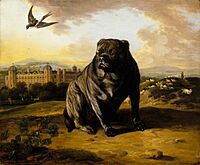
A Dutch Mastiff (called 'Old Vertue') with Dunham Massey in the Background (Jan Wyck, 1700)
-
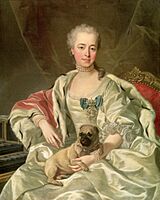
A portrait of Princess Ekaterina Golitsyna by Louis-Michel van Loo (1759)
Moscow, Pushkin Museum of Fine Arts -
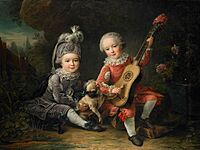
Children of the Marquis de Béthune with a Pug, 1761
-
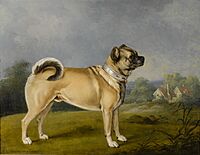
A male Pug, 1802
-
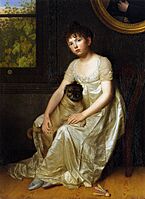
Portrait of Sylvie de la Rue, circa 1810
-
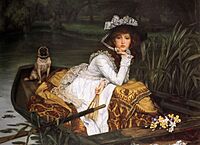
Young Lady in a Boat with a Pug by James Tissot, 1870
-
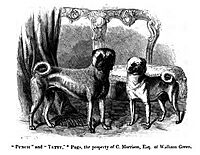
Engraving of the Pugs "Punch and Tetty" from the 1859 book "The Dog in Health and Disease"
-
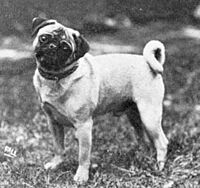
Pug from 1915.
-
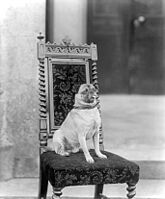
Pug photo, ca 1900. Note its small head and long legs.
-
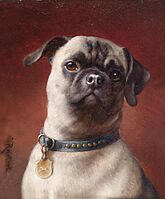
A Pug by Carl Reichert. (1836–1918)
_-_A_Dutch_Mastiff_(called_%27Old_Vertue%27%5E)_with_Dunham_Massey_in_the_Background_-_932341_-_National_Trust.jpg)


.jpg)


.jpg)

Famous Pug Owners in History
Throughout history, world leaders, artists, and modern celebrities have opened their hearts to pugs. Royalty such as William the Silent and Empress Joséphine cherished them as brave companions. In Great Britain, Queen Victoria created special kennel nurseries for her champion pugs, and her royal descendants continued that proud hobby.
In modern times, musicians and actors love having playful pugs at home. Celebrities like singer Billy Joel and singer Belinda Carlisle have shared stories about their funny pug antics. Movie actors Jessica Alba and Gerard Butler, along with television stars Kelly Brook and Nicola Roberts, have also cared for pet pugs. These sweet dogs continue to prove that big charm fits inside a small, wrinkly package.
See also
 In Spanish: Pug para niños
- Companion dog
- Lap dog
- Order of the Pug
- Canis
